

From school fields to the French Riviera – Groundtel’s line-marking operation continues to grow
A year on from sharing how robotic line marking had transformed its operation, family-run grounds maintenance contractor Groundtel Ltd has continued to invest – adding a third TinyLineMarker to its fleet and already looking towards a potential fourth.
Servicing more than 150 schools alongside sports grounds and other prestigious sites, Groundtel has developed a substantial line-marking operation combining the efficiency and accuracy of GPS robotic technology with decades of practical grounds maintenance experience.
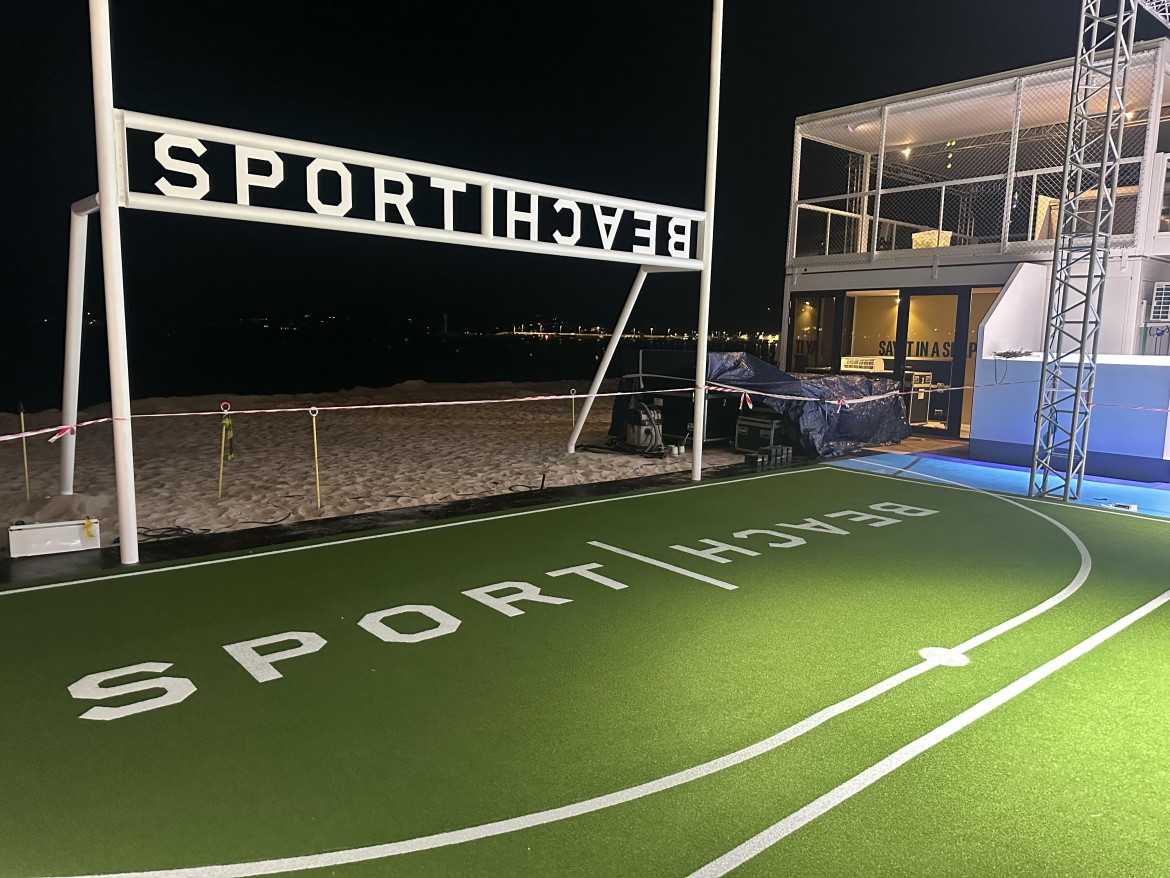
And recently, that experience took the company considerably further afield – all the way to Cannes in the south of France.
For Contracts Manager Danny Perkins, a member of the family behind Groundtel, the company's continued investment in robotic technology demonstrates just how important line marking has become to the business.
“When we bought our first robot in 2021, we knew fairly quickly that it was going to change the way we worked,” says Danny.
“The second gave us the capacity to really start pushing what we could achieve. We've now invested in our third and we're already looking at potentially adding a fourth in the near future.
“They've gone from being something new that we were trying to becoming an essential part of how we operate.”
Three robots – and counting
Groundtel's 20-strong grounds team maintains more than 150 school sites, with line marking accounting for a significant seasonal workload.
During the summer months, this includes 100m, 200m, 300m and 400m athletics tracks, complete with relay boxes, alongside rounders and softball pitches and throwing areas for javelin, discus and shot putt.
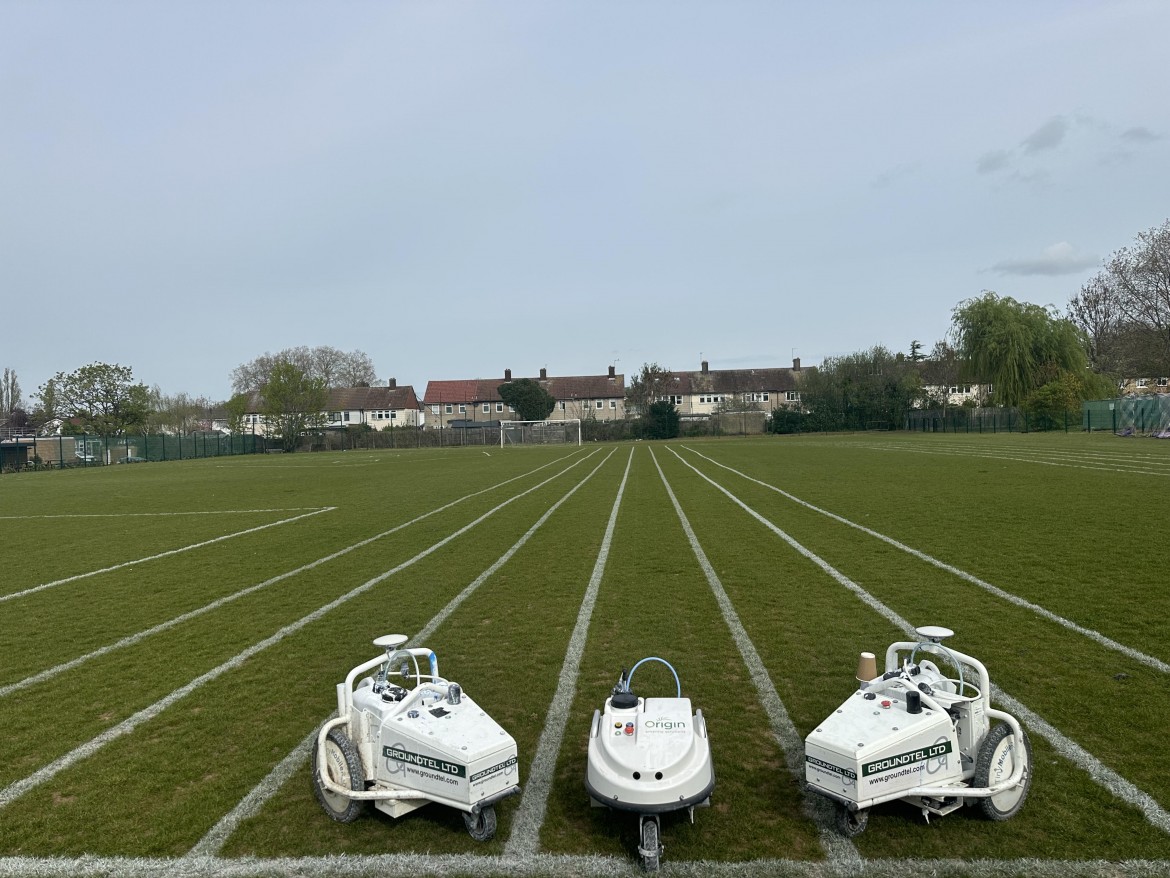
As the seasons change, the focus switches predominantly to football and rugby pitches, training grids and regular overmarking.
Managing that volume across so many sites makes efficiency essential – but not at the expense of accuracy.
“The biggest benefit for us is the amount of work we can get through while maintaining the same standard,” Danny explains.
“At peak times, we've been known to overmark more than 100 schools in seven to ten days. Before the robots, getting through that volume of work could take around four weeks.
“When you're dealing with that many sites, saving a few minutes on one pitch isn't really the point. It's the cumulative saving across hundreds of markings that completely changes the operation.”
Initial marking has seen an even greater transformation.
Before GPS robotic technology, Groundtel relied on traditional pedestrian markers alongside tape measures, string lines and considerable manual setting out.
Today, templates can be selected and accurately positioned using the TinyLineMarker system, with locations retained for subsequent visits.
“The accuracy is something you almost start taking for granted,” Danny says.
“We can return to a school after the grass has been cut, the weather has been poor and the previous lines have virtually disappeared, and the robot still knows exactly where that pitch or track should be.
“For schools with multiple sports marked across one playing field, that consistency makes a huge difference.”
Investment that keeps delivering
Groundtel took delivery of its first TinyLineMarker Pro X in 2021, adding a second machine around 12 to 18 months later.
The success of those first two machines has now resulted in the purchase of a third robot, increasing capacity further during the company's busiest periods.
A fourth machine is already under consideration.
“We don't invest in equipment simply for the sake of having the latest technology,” says Danny. “It has to make commercial sense and, more importantly, improve the service we're giving our customers.
“With these robots, we've seen both.
“We've increased productivity, reduced manual setting out, improved consistency and given ourselves the capacity to take on more work.
“The fact that we started with one, went to two, have now bought our third and are already discussing a fourth probably says more than anything about how successful they've been for us.”
The compact size of the TinyLineMarker remains particularly important to Groundtel's operation. With teams moving between numerous schools each day, machinery needs to be easily transported and, where necessary, handled by one operative.
School playing fields can also be rough, uneven and heavily used, making the ability to operate consistently across imperfect surfaces particularly valuable.
The battery-powered machines are quiet and produce no exhaust emissions while operating – another advantage when Groundtel teams are working around pupils and staff during the school day.
More than sports pitches
While servicing more than 150 schools provides the scale behind Groundtel's line-marking operation, the company's expertise extends considerably beyond conventional sports markings.
Over the years, Groundtel has increasingly been asked to produce unusual, bespoke and large-scale designs.
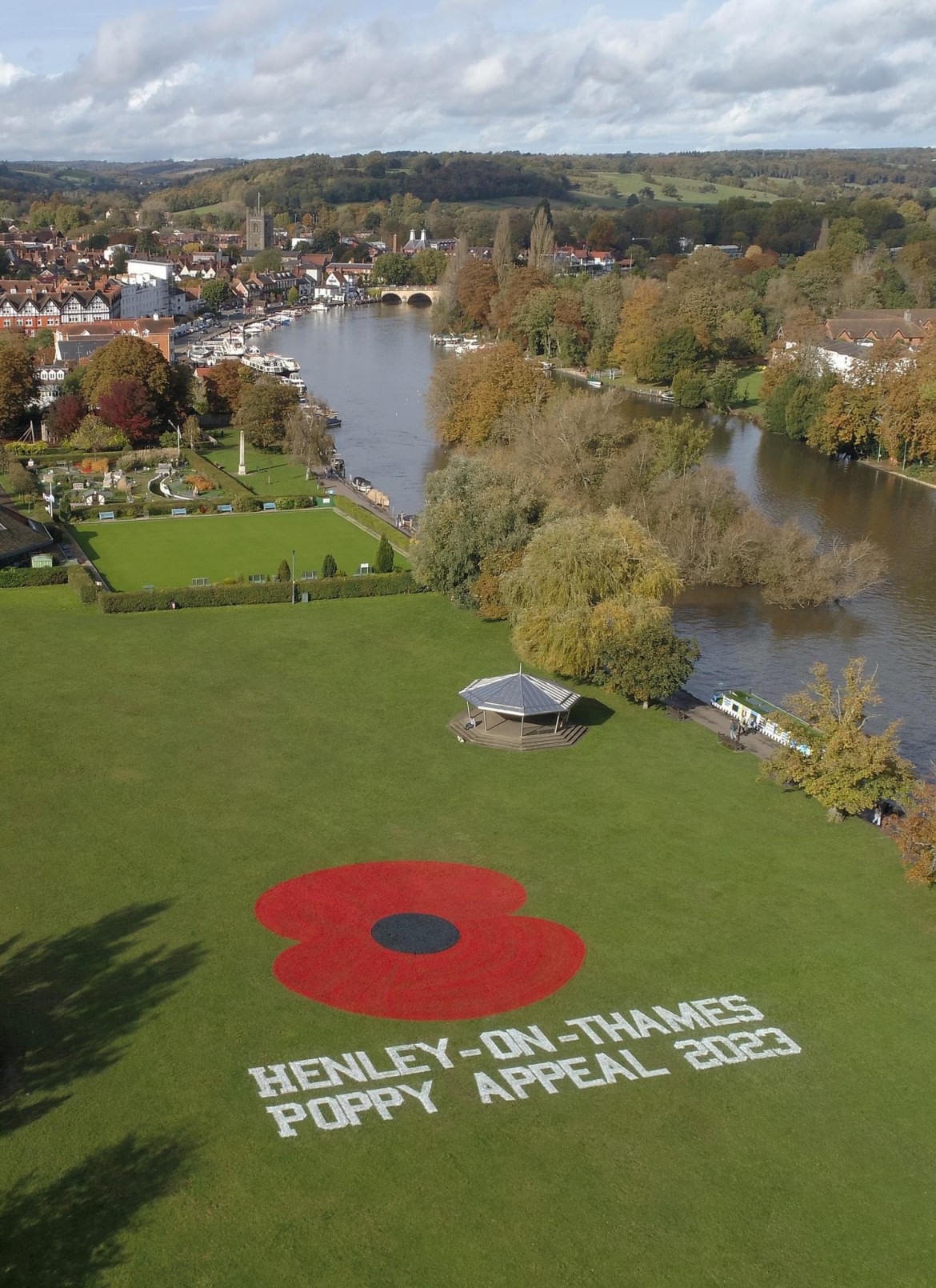
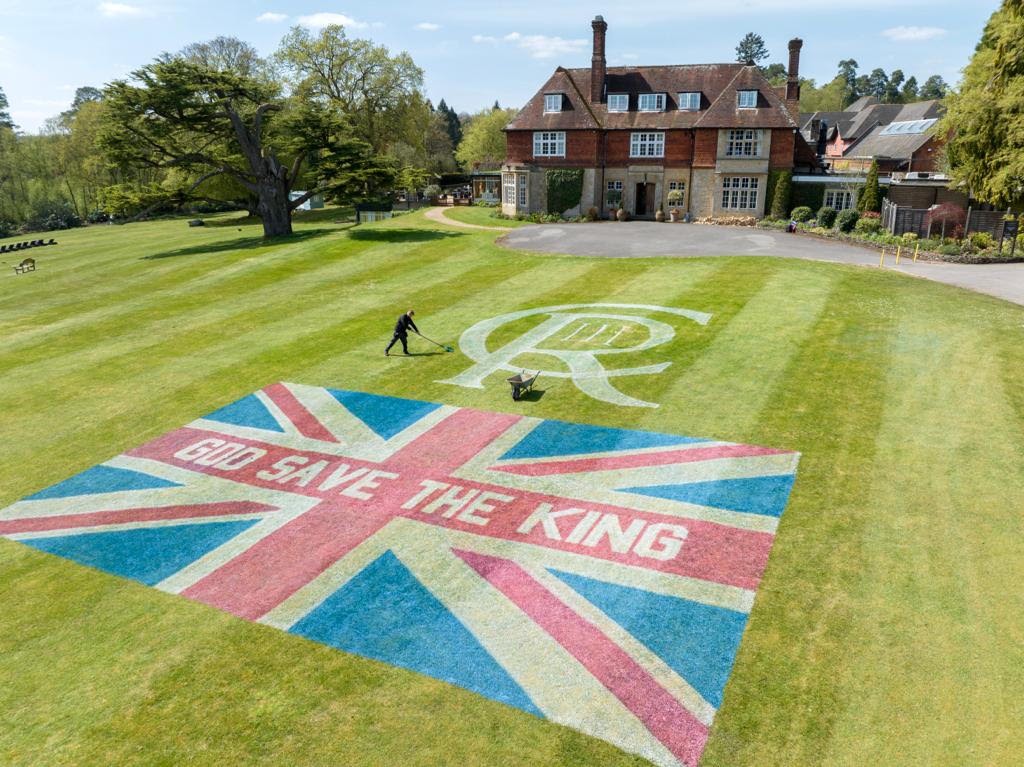
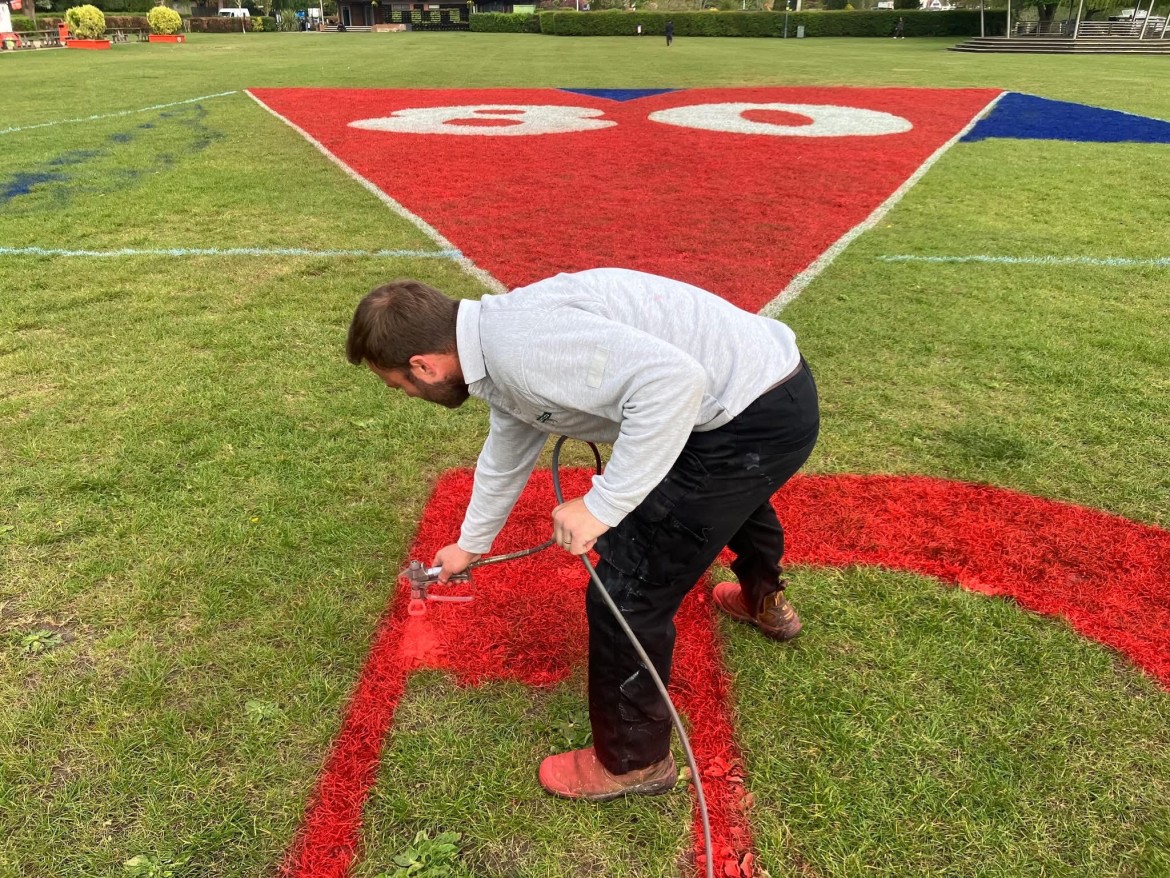
Its specialist work has included huge remembrance poppies and lettering alongside the Thames at Henley-on-Thames, large-scale Union Jacks and royal cyphers for the King's Coronation at prestigious properties, bespoke logos at hotels and stately buildings, and enormous lettering at elite football grounds.
Some of the finished designs are best appreciated from the air, with individual elements stretching many metres across the turf.
“We've produced some pretty unusual markings over the years,” Danny explains.
“When you're creating a huge poppy, Union Jack, logo or lettering that's designed to be viewed from a distance, you need to understand proportions, setting out and how a design is going to translate when it's enlarged onto grass.
“It's very different from marking a standard football pitch, but it's something we've become very comfortable doing.”
That experience proved particularly valuable when the opportunity arose to take Groundtel's specialist line-marking capability overseas.
From the UK to Cannes
Groundtel recently travelled to Cannes in the south of France to complete a bespoke marking project for Sport Beach.
It was the first time the company had taken this type of operation abroad – but importantly, not the first time it had tackled complex, large-scale bespoke marking.
“Cannes was a first for us geographically, but not technically,” says Danny.
“We'd never taken the operation abroad before, but when it came to taking a design, scaling it up, setting it out accurately and spraying a professional finish, that's something we've been doing for years.
“The new challenge was getting ourselves, the equipment and everything we needed a thousand miles across Europe.”
The Sport Beach project involved creating bespoke sports-court markings alongside a large central SB logo and SPORT|BEACH branding on newly installed artificial grass ahead of the event in Cannes.
While the scale and precision of the design were familiar territory for Groundtel, the new artificial surface presented a different challenge.
Rather than arriving in France and experimenting on site, Groundtel carried out preparation and testing in the UK beforehand.
“The surface was probably the biggest unknown,” Danny says.
“We knew we could set the design out and spray it – that's what we do – but we needed to understand how the paint would behave on brand-new artificial grass.
“We carried out tests beforehand, looked at different application methods and made sure we had a process we were confident with before we left.
“By the time we arrived in Cannes, we knew exactly what we wanted to do.”
A different kind of challenge
If the marking itself was familiar territory, getting a commercial grounds operation from the UK to the south of France certainly wasn't.
Groundtel transported specialist marking equipment, sprayers, stencils and supporting equipment by van, while also navigating the additional customs documentation required to temporarily take commercial equipment into Europe.
“That was probably the part that took us furthest outside our normal comfort zone,” Danny admits.
“We're used to organising teams, machinery and materials across more than 150 sites at home. Taking commercial equipment across international borders brings a completely different layer of planning.
“Once we actually got to Cannes and started setting everything out, it almost felt like the easy part. We knew how to produce the design; we just happened to be doing it a thousand miles from home.”
The completed Sport Beach installation provided a striking demonstration of how expertise developed through years of sports ground maintenance and specialist marking can be applied far beyond a conventional playing field.
Technology backed by experience
Despite Groundtel's increasing reliance on robotic technology, Danny is keen to emphasise that the machines complement rather than replace the experience behind the operation.
Groundtel continues to use pedestrian line-marking equipment alongside its robotic fleet and uses IMPACT® Pro ready-to-use paint from Origin Amenity Solutions across its regular sports-marking programme.
“The robots are an incredible tool, but you've still got to understand line marking,” Danny says.
“You need to know how a pitch should be laid out, how different surfaces behave, what finish you're trying to achieve and what to do when a site isn't perfectly flat or straightforward.
“Then you've got the bespoke jobs where there isn't necessarily a template waiting for you. That's where the experience of the people doing the work really comes into it.”
For Groundtel, that combination of experienced operators and modern technology has become central to the continued development of its line-marking service.
Looking ahead
For a family business with more than three decades of grounds maintenance experience, the progression from traditional pedestrian marking to a fleet of three GPS robots represents a significant change in how work is delivered.
But the principles behind the service remain much the same.
“Technology has allowed us to become quicker and more efficient, but ultimately our customers still judge us on the finished job and the service we give them,” says Danny.
“Whether that's marking a school football pitch, setting out a 400-metre athletics track, spraying a giant poppy or Union Jack, producing huge lettering at a football ground or travelling to Cannes for a completely bespoke project, the principle is the same – do the job properly and make sure it looks right.”
With more than 150 schools to service, three robotic markers now operating within the fleet and the possibility of a fourth being added in the near future, Groundtel is continuing to increase its line-marking capacity.
At the same time, projects such as Sport Beach in Cannes demonstrate just how far that expertise can take the company.
“We're proud of where the business has come from, but we're always looking at what we can do better and what else we can offer,” Danny concludes.
“Going from our first robot in 2021 to three today shows how much this part of the business has developed. Cannes was another milestone for us, and hopefully it won't be the last time we get the opportunity to take what we do somewhere a little different.